إعـــــــلان

تقليص
لا يوجد إعلان حتى الآن.

Biblical Prophecies on the Advent of Muhammad

تقليص
X
 
  • تصفية - فلترة
  • الوقت
  • عرض
إلغاء تحديد الكل
مشاركات جديدة

  • Biblical Prophecies on the Advent of Muhammad


    (3) Biblical Prophecies on the Advent of
    Muhammad , the Prophet of Islam


    The Biblical prophecies on the advent of the Prophet Muhammad are evidence of the truth of Islam for people who believe in the Bible.


    In Deuteronomy 18,Moses stated that God told him: “I will raise up for them a prophet like you from among their brothers; I will put my words in his mouth, and he will tell them everything I command him. If anyone does not listen to my words that the prophet speaks in my name, I myself will call him to account.” (Deuteronomy 18:18-19).1


    From these verses we conclude that the prophet in this prophecy must have the following three characteristics:


    1) That he will be like Moses.


    2) That he will come from the brothers of the Israelites, i.e. the Ishmaelites.


    3) That God will put His words in to the mouth of this prophet and that he will declare what God commands him.


    Let us examine these three characteristics in more depth:

  • #2
    1) A prophet like Moses:


    There were hardly any two prophets who were so much alike as Moses and Muhammad . Both were given a comprehensive law and code of life. Both encountered their enemies and were victorious in miraculous ways. Both were accepted as prophets and statesmen. Both migrated following conspiracies to assassinate them. Analogies between Moses and Jesus overlook not only the above similarities but other crucial ones as well. These include the natural birth, the family life, and death of Moses and Muhammad but not of Jesus. Moreover Jesus was regarded by his followers as the Son of God and not exclusively as a prophet of God, as Moses and Muhammad were and as Muslims believe Jesus was. So, this prophecy refers to the Prophet Muhammad and not to Jesus, because Muhammad is more like Moses than Jesus.


    Also, one notices from the Gospel of John that the Jews were waiting for the fulfillment of three distinct prophecies. The first was the coming of Christ. The second was the coming of Elijah. The third was the coming of the Prophet. This is obvious from the three questions that were posed to John the Baptist: “Now this was John’s testimony, when the Jews of Jerusalem sent priests and Levites to ask him who he was. He did not fail to confess, but confessed freely, “I am not the Christ.” They asked him, “Then who are you? Are you Elijah?” He said, “I am not.” “Are you the Prophet?” He answered, “No.” (John 1:19-21). If we look in a Bible with cross-references, we will find in the marginal notes where the words “the Prophet” occur in John 1:21, that these words refer to the prophecy of Deuteronomy 18:15 and 18:18.2 We conclude from this that Jesus Christ is not the prophet mentioned in Deuteronomy 18:18.


    2) From the brothers of the Israelites:


    Abraham had two sons, Ishmael and Isaac (Genesis 21). Ishmael became the grandfather of the Arab nation, and Isaac became the grandfather of the Jewish nation. The prophet spoken of was not to come from among the Jews themselves, but from among their brothers, i.e. the Ishmaelites. Muhammad , a descendant of Ishmael, is indeed this prophet.


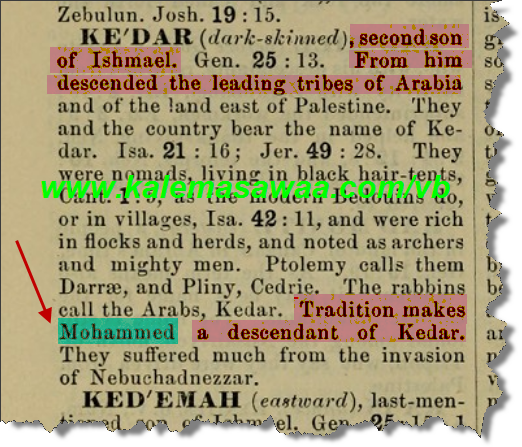
    Also, Isaiah 42:1-13 speaks of the servant of God, His “chosen one” and “messenger” who will bring down a law. “He will not falter or be discouraged till he establishes justice on earth. In his law the islands will put their hope.” (Isaiah 42:4). Verse 11, connects that awaited one with the descendants of Kedar. Who is Kedar? According to Genesis 25:13, Kedar was the second son of Ishmael, the ancestor of the Prophet Muhammad .


    3) God will put His words in the mouth of this prophet:


    The words of God (the Holy Quran) were truly put into Muhammad’s mouth. God sent the Angel Gabriel to teach Muhammad the exact words of God (the Holy Quran) and asked him to dictate them to the people as he heard them. The words are therefore not his own. They did not come from his own thoughts, but were put into his mouth by the Angel Gabriel. During the life time of Muhammad , and under his supervision, these words were then memorized and written by his companions.


    Also, this prophecy in Deuteronomy mentioned that this prophet will speak the words of God in the name of God. If we looked to the Holy Quran, we will find that all its chapters, except Chapter 9, are preceded or begin with the phrase, “In the Name of God, the Most Gracious, the Most Merciful.”


    Another indication (other than the prophecy in Deuteronomy) is that Isaiah ties the messenger connected with Kedar with a new song (a scripture in a new language) to be sung to the Lord (Isaiah 42:10-11). This is mentioned more clearly in the prophecy of Isaiah: “and another tongue, will he speak to this people” (Isaiah 28:11 KJV). Another related point, is that the Quran was revealed in sections over a span of twenty-three years. It is interesting to compare this with Isaiah 28 which speaks of the same thing, “For it is: Do and do, do and do, rule on rule, rule on rule; a little here, a little there.” (Isaiah 28:10).


    Note that God has said in the prophecy of Deuteronomy 18, “If anyone does not listen to my words that the prophet speaks in my name, I myself will call him to account.” (Deuteronomy, 18:19). This means that whoever believes in the Bible must believe in what this prophet says, and this prophet is the Prophet Muhammad .

    تعليق


    • #3
      There were hardly any two prophets who were so much alike as Moses and Muhammad . Both were given a comprehensive law and code of life. Both encountered their enemies and were victorious in miraculous ways. Both were accepted as prophets and statesmen. Both migrated following conspiracies to assassinate them. Analogies between Moses and Jesus overlook not only the above similarities but other crucial ones as well. These include the natural birth, the family life, and death of Moses and Muhammad but not of Jesus. Moreover Jesus was regarded by his followers as the Son of God and not exclusively as a prophet of God, as Moses and Muhammad were and as Muslims believe Jesus was. So, this prophecy refers to the Prophet Muhammad and not to Jesus, because Muhammad is more like Moses than Jesus.


      Also, one notices from the Gospel of John that the Jews were waiting for the fulfillment of three distinct prophecies. The first was the coming of Christ. The second was the coming of Elijah. The third was the coming of the Prophet. This is obvious from the three questions that were posed to John the Baptist: “Now this was John’s testimony, when the Jews of Jerusalem sent priests and Levites to ask him who he was. He did not fail to confess, but confessed freely, “I am not the Christ.” They asked him, “Then who are you? Are you Elijah?” He said, “I am not.” “Are you the Prophet?” He answered, “No.” (John 1:19-21). If we look in a Bible with cross-references, we will find in the marginal notes where the words “the Prophet” occur in John 1:21, that these words refer to the prophecy of Deuteronomy 18:15 and 18:18.2 We conclude from this that Jesus Christ is not the prophet mentioned in Deuteronomy 18:18.


      2) From the brothers of the Israelites:


      Abraham had two sons, Ishmael and Isaac (Genesis 21). Ishmael became the grandfather of the Arab nation, and Isaac became the grandfather of the Jewish nation. The prophet spoken of was not to come from among the Jews themselves, but from among their brothers, i.e. the Ishmaelites. Muhammad , a descendant of Ishmael, is indeed this prophet.


      Also, Isaiah 42:1-13 speaks of the servant of God, His “chosen one” and “messenger” who will bring down a law. “He will not falter or be discouraged till he establishes justice on earth. In his law the islands will put their hope.” (Isaiah 42:4). Verse 11, connects that awaited one with the descendants of Kedar. Who is Kedar? According to Genesis 25:13, Kedar was the second son of Ishmael, the ancestor of the Prophet Muhammad .


      3) God will put His words in the mouth of this prophet:


      The words of God (the Holy Quran) were truly put into Muhammad’s mouth. God sent the Angel Gabriel to teach Muhammad the exact words of God (the Holy Quran) and asked him to dictate them to the people as he heard them. The words are therefore not his own. They did not come from his own thoughts, but were put into his mouth by the Angel Gabriel. During the life time of Muhammad , and under his supervision, these words were then memorized and written by his companions.


      Also, this prophecy in Deuteronomy mentioned that this prophet will speak the words of God in the name of God. If we looked to the Holy Quran, we will find that all its chapters, except Chapter 9, are preceded or begin with the phrase, “In the Name of God, the Most Gracious, the Most Merciful.”


      Another indication (other than the prophecy in Deuteronomy) is that Isaiah ties the messenger connected with Kedar with a new song (a scripture in a new language) to be sung to the Lord (Isaiah 42:10-11). This is mentioned more clearly in the prophecy of Isaiah: “and another tongue, will he speak to this people” (Isaiah 28:11 KJV). Another related point, is that the Quran was revealed in sections over a span of twenty-three years. It is interesting to compare this with Isaiah 28 which speaks of the same thing, “For it is: Do and do, do and do, rule on rule, rule on rule; a little here, a little there.” (Isaiah 28:10).


      Note that God has said in the prophecy of Deuteronomy 18, “If anyone does not listen to my words that the prophet speaks in my name, I myself will call him to account.” (Deuteronomy, 18:19). This means that whoever believes in the Bible must believe in what this prophet says, and this prophet is the Prophet Muhammad .

      تعليق


      • #4
        هنا الترجمه للموضوع وهي تفصيل للنبؤة التي وردت في الكتاب المقدس وتبشر بقدوم النبي محمد صلى الله عليه وسلم. https://www.ebnmaryam.com/vb/t198337.html#post588630

        تعليق


        • #5
          There are none.

          تعليق


          • #6
            There are none.
            Yes, there are. Pandora, your Bible disappoints you, read:

            The Book of Isaiah 21:13-16

            The burden upon Arabia. In the forest in Arabia shall ye lodge, O ye travelling companies of Dedanim.
            The inhabitants of the land of Tema brought water to him that was thirsty, they prevented with their bread him that fled.
            For they fled from the swords, from the drawn sword, and from the bent bow, and from the grievousness of war.
            For thus hath the LORD said unto me, Within a year, according to the years of an hireling, and all the glory of Kedar shall fail:


            In "Dictionary of the Bible"


            page : 494


            If you do not believe in this, can you explain to us what does your Lord mean? Can you give us a brief explanation about what is going on in the mentioned verses?


            Peace to you.
            بسم الله الرحمن الرحيم
            قل هو الله احد * الله الصمد * لم يلد و لم يولد * و لم يكن له كفوا احد
            Dis : " Lui, Dieu, est Un ! * Dieu est le Soutien universel ! * Il n'engendre pas et Il n'est pas engendré, * et Il n'a pas d'égal. "

            تعليق


            • #7
              المشاركة الأصلية بواسطة هشيم مشاهدة المشاركة
              Yes, there are. Pandora, your Bible disappoints you, read:

              The Book of Isaiah 21:13-16

              The burden upon Arabia. In the forest in Arabia shall ye lodge, O ye travelling companies of Dedanim.
              The inhabitants of the land of Tema brought water to him that was thirsty, they prevented with their bread him that fled.
              For they fled from the swords, from the drawn sword, and from the bent bow, and from the grievousness of war.
              For thus hath the LORD said unto me, Within a year, according to the years of an hireling, and all the glory of Kedar shall fail:


              In "Dictionary of the Bible"


              page : 494


              If you do not believe in this, can you explain to us what does your Lord mean? Can you give us a brief explanation about what is going on in the mentioned verses?


              Peace to you.
              No my friend, my Bible could never disappoint me. :) you try hard to find references to Mohammed in the Bible, but they are not there. I even heard once that Mohammed's name was mentioned in the "Song of Solomon"!!!! I was amazed that muslims would wish their esteemed Prophet would be mentioned in such a work. Obviously a misunderstanding of the nature of the work in question. The same misunderstanding that you have in the Book of Isaiah. You see words Arabia... Tema... And Kedar and because you can connect these words with your prophet you take it as a prophecy referring to Mohammed himself. Ignoring the context and the theme of the Book of Isaiah, which is about Gods judgement against rebellious nations, primarily Judah and Jerusalem. Given that fact why would you expect to find Mohammed there? The latter half of the Book deals with the redemptive work of the promised messiah, again why would you suppose to find reference to Mohammed here? Did Mohammed ever claim to be the promised messiah? No.

              The link give an explanation about Isaiah and his prophecies. I hope you take the time to read it he was an extremely interesting man and a great prophet.

              https://christianity.about.com/od/old...saiahintro.htm

              Peace to you also.

              تعليق


              • #8
                This is a prophetic passage and has nothing to do with (Gods judgement against rebellious nations, primarily Judah and Jerusalem) which the Book of Isaiah. Babylon is concerned not (Kedar, Tema.....)
                بسم الله الرحمن الرحيم
                قل هو الله احد * الله الصمد * لم يلد و لم يولد * و لم يكن له كفوا احد
                Dis : " Lui, Dieu, est Un ! * Dieu est le Soutien universel ! * Il n'engendre pas et Il n'est pas engendré, * et Il n'a pas d'égal. "

                تعليق


                • #9
                  Divine Light From Paran

                  The prophecies of the Bible had even led its followers to that part of the world where the great Prophet was to appear. Thus it was said:

                  And he said, the Lord came from Sinai, and rose up from Seir unto them; and shined forth from Mount Paran and he came with ten thousands of saints: from his right hand went a fiery law for them. (Deuteronomy 33:2)

                  In this verse Moses is promised three manifestations of the glory of God. The first of these appeared on Sinai in the time of Moses. Time passed. The second manifestation promised in the prophecy was to take place at Seir, a part of the world near where the miracles of Jesus took place. "Rising up from Seir," therefore, meant the advent of Jesus.

                  The third manifestation of divine glory was to take its rise from Paran, and Paran (Arabic Faran) is the name of the hills which lie between Mecca, the birth place of Muhammad, and Medina, the town where he died. According to the Old Testament, Ishmael, the ancestor of Muhammad, lived in this part. Thus we have in the Bible:

                  And God was with the lad (Ishmael): and he grew, and dwelt in the wilderness, and became an archer. And he dwelt in the wilderness of Paran. (Genesis 21:20-21)
                  بسم الله الرحمن الرحيم
                  قل هو الله احد * الله الصمد * لم يلد و لم يولد * و لم يكن له كفوا احد
                  Dis : " Lui, Dieu, est Un ! * Dieu est le Soutien universel ! * Il n'engendre pas et Il n'est pas engendré, * et Il n'a pas d'égal. "

                  تعليق


                  • #10
                    This advent was also prophesied by Habakkuk several centuries before Jesus.

                    Thus we have:

                    God comes from Teman, and the Holy One from Mount Paran. Selah. His glory covered the heavens, and the ea11h was full of his praise. And his brightness was as the light; he had horns coming out of his hand5: and there was the hiding of his power. Before him went the pestilence, and the burning coals went fo11h at his feet. He stood and measured the earth: he beheld, and drove asunder the nations; and the everlasting mountains were scattered, and the perpetual hills did bow: his ways are everlasting. I saw the tents of Cushan in affliction; and the cu11ain of the land of Midian did tremble. (Habakkuk 3:3-7)

                    This again shows that the third manifestation mentioned earlier was going to be by one who would appear from the land of Tema and Mount Paran. The earth was going to be full of his praise. It is not a mere accident, then, that the Holy Prophet of Islam was named Muhammad, which literally means, the Praised One. Only a man with a name as beautiful as his personality and character could answer to the description of Habakkuk.The enemies of Muhammad suffered destruction, pestilence and humiliation of "burning coals" in encountering him in spite of overwhelmingly stronger and larger forces.

                    Moses died while he was still fighting his enemies. Jesus was put on the Cross. The prophet who beheld and drove the nations asunder, as mentioned by Habakkuk,could be, there- fore, none else but Muhammad. His enemies who looked like "everlasting mountains and perpetual hills" with their immense power were completely routed. Later "the tents of Cushan" and the "curtains of the land of Midian," that is, the land of Canaan then under the Roman Caesar, also found their salvation in surrendering to the servants of the Holy Prophet in the time of that Caesar's successors.
                    التعديل الأخير تم بواسطة هشيم; الساعة 11-02-2014, 01:40.
                    بسم الله الرحمن الرحيم
                    قل هو الله احد * الله الصمد * لم يلد و لم يولد * و لم يكن له كفوا احد
                    Dis : " Lui, Dieu, est Un ! * Dieu est le Soutien universel ! * Il n'engendre pas et Il n'est pas engendré, * et Il n'a pas d'égal. "

                    تعليق


                    • #11
                      المشاركة الأصلية بواسطة هشيم مشاهدة المشاركة
                      This is a prophetic passage and has nothing to do with (Gods judgement against rebellious nations, primarily Judah and Jerusalem) which the Book of Isaiah. Babylon is concerned not (Kedar, Tema.....)
                      With all due respect I believe you are wrong in your assumptions. Isaiah prophecies were concerning the wrath of God against rebellious nations.

                      586 B.C. - Judah (Southern Kingdom) conquered by Babylon. Jerusalem destroyed, including the first Temple, and the Jews exiled to Babylon.

                      538 B.C. - The exiles return to Jerusalem from Babylon.

                      The Book of Isaiah was written about 740-680 B.C. Given the historical context and location do you not believe it more logical to believe that Isaiah was referring to Judah and Jerusalem and the conflict with Babylon? Given that this occurred hundreds of years before the birth of Christ Jesus, and given that the latter prophecies of Isaiah dealt with the coming of the Messiah, a title given to Jesus.. Both in the Bible and Quran.. Would it not be reasonable to assume that this prophecy that you believe refers to Mohammed was fulfilled the best part of a thousand years before Mohammed was born in 570.

                      Again of course you are free to interpret the previous scriptures as you will. Yet if Mohammed was prophesied in the Bible, I believe it would have been clearer, in a work the size and scope of the Bible there would have been more referrals than the mere handful that muslims like to lay claim to. Even these verses have to be seen outside of the biblical context in which they are set to even remotely appear to refer to Mohammed. It just does not seem logical.

                      Peace.

                      تعليق


                      • #12
                        المشاركة الأصلية بواسطة التواقة الى الجنة مشاهدة المشاركة


                        (3) Biblical Prophecies on the Advent of
                        Muhammad , the Prophet of Islam


                        The Biblical prophecies on the advent of the Prophet Muhammad are evidence of the truth of Islam for people who believe in the Bible.


                        In Deuteronomy 18,Moses stated that God told him: “I will raise up for them a prophet like you from among their brothers; I will put my words in his mouth, and he will tell them everything I command him. If anyone does not listen to my words that the prophet speaks in my name, I myself will call him to account.” (Deuteronomy 18:18-19).1


                        From these verses we conclude that the prophet in this prophecy must have the following three characteristics:


                        1) That he will be like Moses.


                        2) That he will come from the brothers of the Israelites, i.e. the Ishmaelites.


                        3) That God will put His words in to the mouth of this prophet and that he will declare what God commands him.


                        Let us examine these three characteristics in more depth:
                        To address this issue of Mohammed being the prophet inferred in Deuteronomy 18 and why it cannot apply to Mohammed, I do not see the need for greater depth as it's quite clear why it clear it cannot be He. If you are to take the bible as your source then you have to see it in biblical context and understand when the book was written who was its target audience and what was it telling them. You cannot apply your own reasonings to make it appear to infer what you wish. Deuteronomy was written primarily for the Israelites. So it does not matter how you take the meaning of "brethren" and so see Mohammed could be brethren to the Israelites through Ishmael... What determines the meaning is how "brethren" is used in the Bible, during that time and who did the term encompass. The term brethren was always used in reference to fellow Israelites, Moses meant that the prophet would come out of the 12 Israelite tribes who were from Isaac not Ishmael, at no point in the Old Testament are the descendants of Ishmael known by the term "brethren" to the Israelites. All of this shows that Muhammad could not be the prophet Moses foretold. The only acceptable, logical context for Moses' words is that "the prophet" must be an Israelite. No non-Israelite can meet the requirement. Muhammad was not an Israelite and thus he could not have fulfilled the conditions Moses set forth. Jesus is the prophet Moses foretold.

                        Additional implicit requirements to make this prophet "like unto Moses" can be found in the last verses in Deuteronomy 34.10-12:
                        "And there has not arisen a prophet since in Israel like Moses, (2) whom the Lord knew face to face, none like him for all the (3) signs and wonders which the Lord sent him to do in the land of Egypt, to Pharaoh and to all his servants and to all his land, and for all the mighty power and all the great and terrible deeds which Moses performed in the sight of all Israel." From this I see the requirements thus....

                        1.. this future prophet is to speak the words that God puts in his mouth.
                        2.. this future prophet would speak with God face to face
                        3.. this future prophet would perform miracles, signs, and wonders.

                        The prophets speaks the words of God...God puts words in mouth... Jesus spoke with God directly, Jesus is Gods word. Mohammed did not receive his revelation from God but through a spirit, believed to be Angel Gabriel. Jesus spoke with God face to face, Jesus showed he had existed with God the father from eternity. Moses also spoke with God face to face. Mohammed did not. Jesus performed miracles, as did Moses, the Quran does not record Mohammed performing any miracles and Mohammed himself denied he was given powers to perform miracles.

                        One very important similarity between Moses and Jesus was that they each mediated a covenant. Moses was the mediator of the Old Covenant (Testament), Christ of the New Covenant, or Testament. (Exodus 19 and 20, Hebrews 12:24). Muhammad did not bring a covenant. Unless you can tell me of a covenant Mohammed, it appears to me from what I have read that muslims maybe see themselves as following the Abrahamic covenant first made with the children of Israel.
                        peace.

                        تعليق


                        • #13
                          Again of course you are free to interpret the previous scriptures as you will.
                          No, we are not free to do so. Look at this verse from you book:

                          Divine Light From Paran

                          The prophecies of the Bible had even led its followers to that part of the world where the great Prophet was to appear. Thus it was said:

                          And he said, the Lord came from Sinai, and rose up from Seir unto them; and shined forth from Mount Paran and he came with ten thousands of saints: from his right hand went a fiery law for them. (Deuteronomy 33:2)
                          We have the same referred to i our Holy Quran. Your Bible, after many stages of disappearance then re-written the mistakes in translation, Allah Almighty wanted these verses to remain untouched so that one day it is going to be a witness to our Prophet and Holy Quran.

                          Now it seems logical.


                          Peace
                          بسم الله الرحمن الرحيم
                          قل هو الله احد * الله الصمد * لم يلد و لم يولد * و لم يكن له كفوا احد
                          Dis : " Lui, Dieu, est Un ! * Dieu est le Soutien universel ! * Il n'engendre pas et Il n'est pas engendré, * et Il n'a pas d'égal. "

                          تعليق


                          • #14
                            The verse from Holy Quran having the same meaning of (Deuteronomy 33:2) : Muhammad is the Messenger of Allah; and those with him are forceful against the disbelievers, merciful among themselves. You see them bowing and prostrating [in prayer], seeking bounty from Allah and [His] pleasure. Their mark is on their faces from the trace of prostration. That is their description in the Torah. And their description in the Gospel is as a plant which produces its offshoots and strengthens them so they grow firm and stand upon their stalks, delighting the sowers - so that Allah may enrage by them the disbelievers. Allah has promised those who believe and do righteous deeds among them forgiveness and a great reward. (29) Al-Fath
                            بسم الله الرحمن الرحيم
                            قل هو الله احد * الله الصمد * لم يلد و لم يولد * و لم يكن له كفوا احد
                            Dis : " Lui, Dieu, est Un ! * Dieu est le Soutien universel ! * Il n'engendre pas et Il n'est pas engendré, * et Il n'a pas d'égal. "

                            تعليق


                            • #15
                              I confess I do not see how you arrive at your conclusion about the same inference being found in both books. I accept that that what is in the Quran does indeed refer to Mohammed, but Deuteronomy 33:2 is not referring to a prophet. The LORD.. Is referring to God Himself... YHWH... Of the Old Testament. This is clear if you take the context of the whole Book into consideration.

                              And he said, the Lord came from Sinai, and rose up from Seir unto them; and shined forth from Mount Paran and he came with ten thousands of saints: from his right hand went a fiery law for them. (Deuteronomy 33:2)


                              The only possible way you can claim that Deuteronomy 33:2 is talking about Muhammed is to admit that you believe that Muhammed = God, which all Jews, Christians, and (I should hope) you as a Muslim and indeed all muslims would consider to be blatantly offensive and blasphemous.

                              Also is it logical to look to verses from previous scriptures you believe to have been changed and tampered with by mankind to seek proof of your own dear prophet. Is not the Quran enough for you?

                              Peace.

                              تعليق

                              يعمل...
                              X