 تويت
تويت


God supported His last Prophet Muhammad with many miracles and much evidence which proved that he is a true Prophet sent by God. Also, God supported His last revealed book, the Holy Quran, with many miracles that prove that this Quran is the literal word of God, revealed by Him, and that it was not authored by any human being. This chapter discusses some of this evidence.
(1) The Scientific Miracles
in the Holy Quran

The Quran is the literal word of God, which He revealed to His Prophet Muhammad through the Angel Gabriel. It was memorized by Muhammad , who then dictated it to his Companions. They, in turn, memorized it, wrote it down, and reviewed it with the Prophet Muhammad . Moreover, the Prophet Muhammad reviewed the Quran with the Angel Gabriel once each year and twice in the last year of his life. From the time the Quran was revealed, until this day, there has always been a huge number of Muslims who have memorized all of the Quran, letter by letter. Some of them have even been able to memorize all of the Quran by the age of ten. Not one letter of the Quran has been changed over the centuries.
The Quran, which was revealed fourteen centuries ago, mentioned facts only recently discovered or proven by scientists. This proves without doubt that the Quran must be the literal word of God, revealed by Him to the Prophet Muhammad , and that the Quran was not authored by Muhammad or by any other human being. This also proves that Muhammad is truly a prophet sent by God. It is beyond reason that anyone fourteen hundred years ago would have known these facts discovered or proven only recently with advanced equipment and sophisticated scientific methods. Some examples follow.
A) The Quran on Human Embryonic Development
A) The Quran on Human Embryonic Development:
In the Holy Quran, God speaks about the stages of man’s embryonic development:
We created man from an extract of clay. Then We made him as a drop in a place of settlement, firmly fixed. Then We made the drop into an alaqah (leech, suspended thing, and blood clot), then We made the alaqah into a mudghah (chewed substance)... 1 (Quran, 23:12-14)
Literally, the Arabic word alaqah has three meanings: (1) leech, (2) suspended thing, and (3) blood clot.
In comparing a leech to an embryo in the alaqah stage, we find similarity between the two2 as we can see in figure 1. Also, the embryo at this stage obtains nourishment from the blood of the mother, similar to the leech, which feeds on the blood of others.3
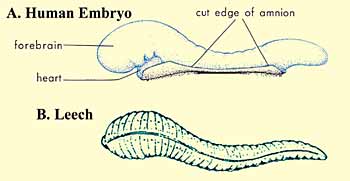
Figure 1: Drawings illustrating the similarities in appearance between a leech and a human embryo at the alaqah stage. (Leech drawing from Human Development as Described in the Quran and Sunnah, Moore and others, p. 37, modified from Integrated Principles of Zoology, Hickman and others. Embryo drawing from The Developing Human, Moore and Persaud, 5th ed., p. 73.)
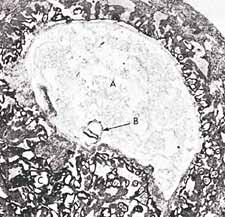
The second meaning of the word alaqah is “suspended thing.” This is what we can see in figures 2 and 3, the suspension of the embryo, during the alaqah stage, in the womb of the mother.
Figure 2: We can see in this diagram the suspension of an embryo during the alaqah stage in the womb (uterus) of the mother. (The Developing Human, Moore and Persaud, 5th ed., p. 66.) (Click on the image to enlarge it.
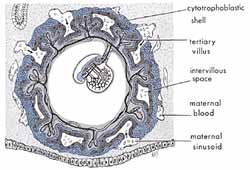
Figure 3: In this photomicrograph, we can see the suspension of an embryo (marked B) during the alaqah stage (about 15 days old) in the womb of the mother. The actual size of the embryo is about 0.6 mm. (The Developing Human, Moore, 3rd ed., p. 66, from Histology, Leeson and Leeson.)
The third meaning of the word alaqah is “blood clot.” We find that the external appearance of the embryo and its sacs during the alaqah stage is similar to that of a blood clot. This is due to the presence of relatively large amounts of blood present in the embryo during this stage4 (see figure 4). Also during this stage, the blood in the embryo does not circulate until the end of the third week.5 Thus, the embryo at this stage is like a clot of blood.
Figure 4: Diagram of the primitive cardiovascular system in an embryo during the alaqah stage. The external appearance of the embryo and its sacs is similar to that of a blood clot, due to the presence of relatively large amounts of blood present in the embryo. (The Developing Human, Moore, 5th ed., p. 65.)
For more Informations about this subject you can visit this web site
https://www.islam-guide.com/frm-ch1-1-h.htm
 هدي أعصابك يا ناديا أحسن من كلامك إللي بينقط سم
تعليق