آخـــر الـــمـــشـــاركــــات





-

شرح المخطوطة
Physical Characteristics:
The seam between this and the last page is readily apparent on the right and has been described in the last page. Otherwise this page is very well preserved and all words are clear with one exception due to scribal error in line 17 in the third from last word on the line.
Paragraphs and Spatiums and Editorial Marks
: As is usual but not always the case the paragraphs and spatiums correspond with current versification. New paragraphs begin: line 7 = 29:1; line 16 = 29:8; and an indentation marks a new paragraph on line 22 = 29:13. There are spatiums marking complete verses: in line 14 = 29:8, line 25 = 29:15; line 28 = 29:18. Editors marks set off 29:13,14 in lines 22 to 25.
Editorial additions:
Line 1: 5th word: (28:24) Q = a yod is edited above "ve-shadad" making it read "ve-yishdad as in M.
Line 4: before 8th word, (28:28): Q = 1st word in vs 28 in M is omitted in Q. see below in variations. 8th word: waw is edited above to make Q " yadak" read "yudak" as in M.
Line 5: above 2nd word: (28:28) Q = "gilgal" is edited to read as M.
Line 17: 3rd word: (29:9) Q = a "he" is edited above a misspelled word. The "he" does not correct the spelling nor fit the word but may be euphonic ta make an open syllable.
Line 20: 2nd word: (29:11) Q = adds an article to "sepher." M = the kithuv is the same as the edited Q but the qer'e: is "sepher" (without article).
Line 26: 5th word (29:15) Q = a euphonic waw is added after (not before as would be expected) aleph in "ro'e:nu."
Line 27: 3rd word (29:16) Q editor added a waw to "yo'mer" for pronunciation.
Variations of the Q text from the Masoretic:
Line 2: 2nd word: (28:25) spelling: Q = ve-kiymon and M = "ve-kamon."
Line 3: 1st word (28:26) Q = "ve-yisre:hu" and M = "ve-yissero." It is the same word but Q has a different spelling for the 3ms suffix. Q = hu and M = o. 3rd word: Q omits yod found in M in "e'lohayv." 8th and 10th words: Q omits waws (o sounds) found in M which is the reverse of what is usually found.
Line 4: 1st word: (28:27) Q = "yasuv" and M = yusav." 8th word: (28:28) Q omits "lechem"(bread) which is the first word in this verse in M. In Q the 2nd from last word in this line: an infinitive of emphasis (lit: threshing he shall thresh) Q spells the word " 'adash" as "hadash" and M = " 'adosh."
Line 6: 1st word: (28:29) Q omits aleph found in M at the end of "hiphliya' ."
Line 9: 6th word: (29:3) Q = "metsudoth" (forts from masadah) and M = "metsuroth" (fences or ramparts).
Line 12: next to last word: (29:6) Q and M have the same spelling but an editor has placed 2 dots under the waw indicating that the M spelling was not acceptable to him in Q. See the 2 dots below and in line 12 above. The dots indicate what the editor felt was a mistaken letter and is not a vowel point. Without the dots the spelling of this word is i
dentical to M. See other corrections using dots in the introducory page
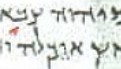
Line 13: 6th word: (29:7) Q has go'yiym spelled with aleph not done so in M.
Line 14 first word: The Q scribe often writes daleth and resh in reverse where it should be resh you find daleth and where you should find daleth he wrote resh. For an example of this often found anomaly compare the first word in line 14 with the 6th word in line 9.
Line 15: 3rd word: (29:8) Q = plural "naphshayv" and M = singular "naphsho."
Line 16: 2nd word: (28:8) (repositioned waw: Q = "sheqoqah" and M = "shoqe:qah"
Line 17: 3rd word: (29:9) a mispelling in Q = "hithshasha-u" This word has a tau edited over it resulting in "hithshatesha-u" and M = "hishta-'a-she-u" which rhymes in meter with the first word of this verse. This verse contains multiple alliterations and play on words. 6th and 7th words: Q = "ve-l'o mey-yayin" and M = ve-l'o yayin" 9th word: The word in Q is obscure and crowded; in harmony with context it should read "me:-l'o" but only "me-l" is visible. M = "ve-l'o."
Line 18: 2nd word: suffix 2mpl: Q = "kemah" and M = "kem."
Line 20: 8th word: (29:11) Q = verb imp "va-yo'mer" and M = verb perf. "va-'amar." Last word: Q = "ve-nathnu" and M = "ve-nithan."
Line 21: 11th word: (29:12) as in 8th of the last line Q = va-yo'mer" and M = "va-'amar."
Line 23: 4th word: (29:13) Q = "yarath" and M = "yiratham;" 10th word: (29:14) Q = "hineh" and M = "hine:niy;" 11th word (29:14) Q = "adonay" not found in M.
Line 24: words 1, 5, 6 "pela" should end with aleph. Q scribe wrote final he for each. Writing he for aleph is a frequent Q error.
Line 25: Last word: (29:15): Q = imp 3ms "va-yehiy" and M = perf. 3ms "ve-hayah."
Line 26: 9th and 10th words: (29:16) Q writes two words and M = same as one word: Q = "haphek mikem" and M = "haphek-ke-kem." The meaning is the same. Word 12 is the next to last in this line. It is " 'im-ke-cham" (with as heat?) (likely a misspelling leaving out a final resh) M = " 'im-kechomer" (by-as clay) with resh added to Q it then corresponds with M.
Line 27: 9th word: (29:16) another misspelling? Q = "chomer" and M = " 'amar." probably more than a mispelling because the text calls for "'amar" (say) but the scribe wrote "chomer" (clay) which is in the context but would not fit in this sentense. It is a human error and passed over by editors who usually correct such errors..
Line 29: 5th word (29:18) Q = add a final "he' to "u-me:'ophel" not in M.
وهذا هو تتبع الكلمة من قاموس الكتاب المقدس:
Bible > Strong's > Hebrew > 7123
◄ 7123. qera ►
Strong's Concordance
qera: to call, read out or aloud
Original Word: קְרָא
Part of Speech: Verb
Transliteration: qera
Phonetic Spelling: (ker-aw')
Short Definition: read
NAS Exhaustive Concordance
Word Origin
(Aramaic) corresponding to qara
Definition
to call, read out or aloud
NASB Translation
called (1), proclaimed (1), read (7), shouted (1), summoned (1).
Brown-Driver-Briggs
[קְרָא] verbcall, read out, aloud (see Biblical Hebrew I. קרא); —
Pe`al Imperfect3masculine singular יִקְרֵהDaniel 5:7, 1singular אֶקְרֵאDaniel 5:17; 3masculine plural יִקְרוֺןDaniel 5:15; InfinitiveלְמִקְרֵאDaniel 5:8; Daniel 5:16; Participle activeקָרֵאDaniel 3:4+; —
Strong's Exhaustive Concordance
call, cry, read
(Aramaic) corresponding to qara' -- call, cry, read.
see HEBREW qara'
Forms and Transliterations
אֶקְרֵ֣אאקרא יִקְר֔וֹן יִקְרֵ֞ה יִתְקְרֵ֖י יקרה יקרון יתקרי לְמִקְרֵ֔אלְמִקְרֵ֗א למקרא קֱרִ֖י קֱרִ֧י קָרֵ֣א קָרֵ֤א קָרֵ֨א קרא קרי
’eq·rê ’eqrê ekRe kaRe keRi lə·miq·rê lemikRe ləmiqrê
qā·rê qārê qĕ·rî qĕrî yikReh yikRon yiq·rêh yiq·rō·wn yiqrêh yiqrōwn yiṯ·qə·rê yitkeRei yiṯqərê
Links
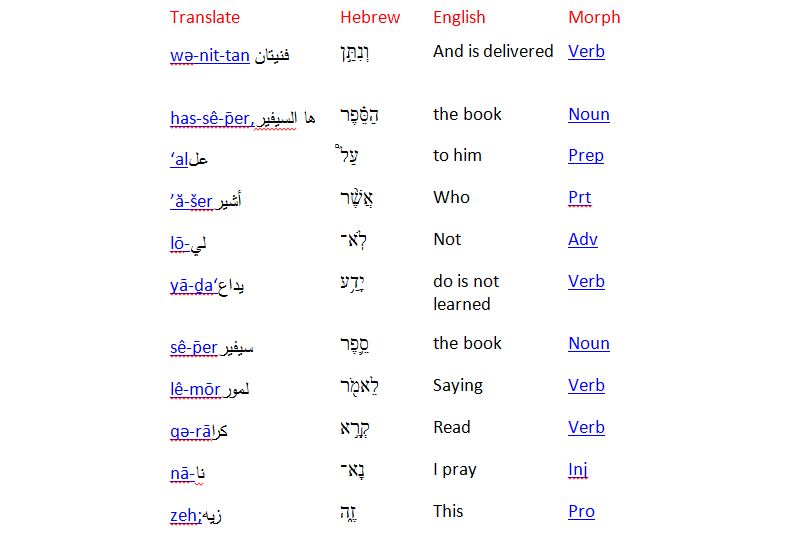
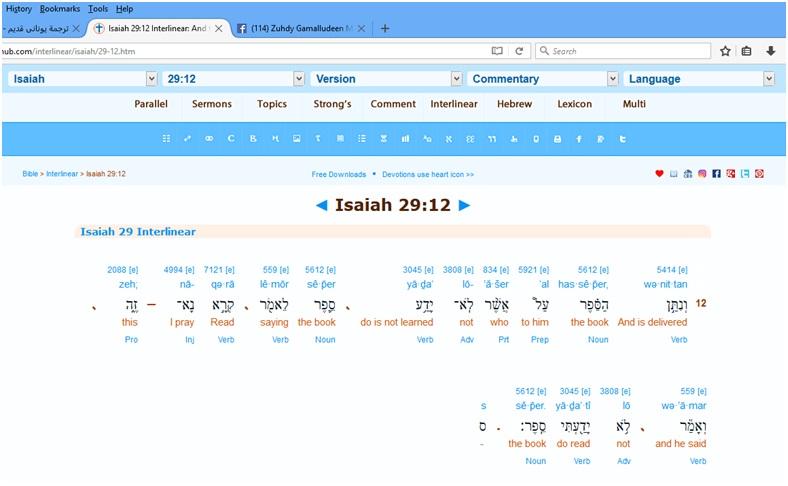
وهنا نجدهم في الفقرة الأولى : يترجمون יִתְּנוּ אֹתוֹ אֶליוֹדֵעַ הספרيترجمونها إلى( يدفعونه
لعارف الكتابة)..الترجمة الصحيحة: (يعطونه لعالم الكتاب) أو( لعارف الكتاب).
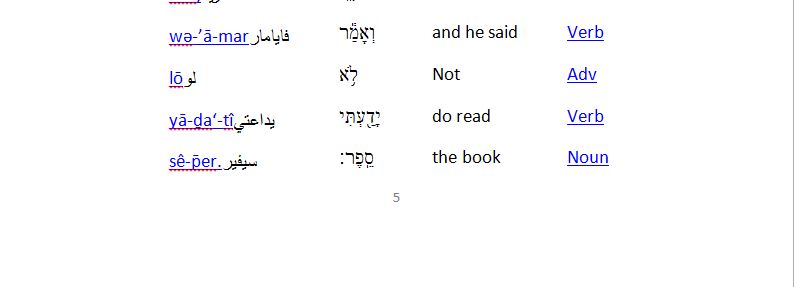
وكذلك في الفقرة الثانية : וְאָמַר לֹא יָדַעְתִּי סֵפֶרيترجمونها فيقول لا اعرف الكتابة.
الترجمة الصحيح : وقال لا أعرف الكتاب أي القراءة ولو كانت الجملةلا أعرف الكتابة لكانت كتابتها بالعبرية هكذا וְאָמַר לֹא יָדַעְתִּילכתוב.
رابعاً: ويبقى النص اليوناني هو الحجة القوية عليهم لأنه الأصل الذي كتب به كتابهم وعنه تمت كافة الترجمات الأخرى..فلنحقق ذلك:
I cannot; for it is sealed "I cannot read it; for it is sealed up" - An ancient MS. and the Septuagint have preserved a word here, lost out of the text; לקרותlikroth, (for לקראות),αναγνωναι anagnonai, read it.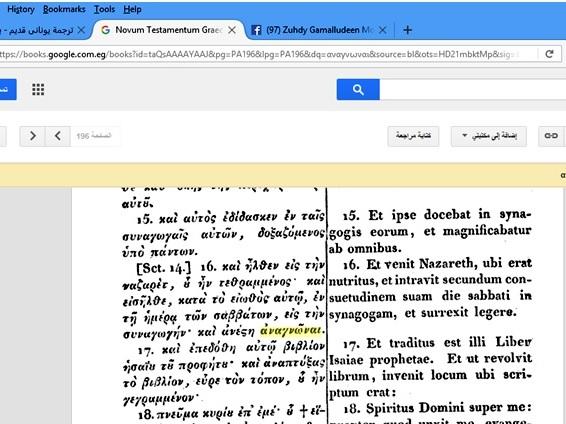
Isaḯas 29:12 καιδοθηϲεταιτοβιβλιοντουτοειϲχιραϲανθρωπου·μηεπιϲταμενουγραμʼματα˙καιεριαυτω·αναγνωθιταυτακαιερι . ουκαιπιϲταμαιγραμʼματα
Isaḯas 29:12 kai dothisetai to vivlion touto eis chiras anthropou : mi epistamenou gramʼmata ˙ kai eri afto : anagnothi tafta kai eri . ouk aipistamai gramʼmata
مرة أخرى..إن آية سفر إشعياء 29: 12 ونصها هو:
[أَوْ يُدْفَعُ الْكِتَابُ بِغَارِ حِرَاءٍلِرجلٍ لاَ يَعْرِفُ الْكِتَابَةَ وَيُقَالُ لَهُ: «اقْرَأْ هذَا». فَيَقُولُ: «لاَ أَعْرِفُ الْقرءاَةَ»."].أشعياء12:29
وبالنظر في مخطوطة سفر إشعياء محل الدراسة سوف نجد ان شراح الكتاب المقدس قاموا بإخفاء كلمةειϲχιραϲ..touto eis chiras.. والتيتعنيفي حراء غار.
ولنتناول ذلك الأمر بالتحليل..
وبداية لنأخذ النص اليوناني في المخطوطة السينائية ونرى ماذا سنجد.. إشعياء 29 نص 12
καιδοθηϲεταιτοβιβλιοντουτοειϲχιραϲανθρωπου·μηεπιϲταμενουγραμʼματα˙καιεριαυτω·αναγνωθιταυτακαιερι . ουκαιπιϲταμαιγραμʼματα
Isaḯas 29:12 kai dothisetai to vivlion touto eis chiras anthropou : mi epistamenou gramʼmata ˙ kai eri afto : anagnothi tafta kai eri . ouk aipistamai gramʼmata
لتحميل كتبي فضلاً الضغط على الصورة التالية - متجدد بإذن الله
معلومات الموضوع
الأعضاء الذين يشاهدون هذا الموضوع
الذين يشاهدون الموضوع الآن: 1 (0 من الأعضاء و 1 زائر)
المواضيع المتشابهه
-
بواسطة محمد سني 1989 في المنتدى شبهات حول القران الكريم
مشاركات: 0
آخر مشاركة: 27-01-2017, 04:39 AM
-
بواسطة ابوغسان في المنتدى المنتدى الإسلامي
مشاركات: 0
آخر مشاركة: 13-09-2015, 04:27 PM
-
بواسطة وردة الإيمان في المنتدى منتدى نصرانيات
مشاركات: 3
آخر مشاركة: 07-12-2014, 12:34 PM
-
بواسطة مسلم77 في المنتدى شبهات حول السيرة والأحاديث والسنة
مشاركات: 4
آخر مشاركة: 17-06-2014, 09:57 AM
-
بواسطة ALNESR ALMASRY في المنتدى منتدى نصرانيات
مشاركات: 0
آخر مشاركة: 04-05-2014, 08:13 PM
الكلمات الدلالية لهذا الموضوع
 ضوابط المشاركة
- لا تستطيع إضافة مواضيع جديدة
- لا تستطيع الرد على المواضيع
- لا تستطيع إرفاق ملفات
- لا تستطيع تعديل مشاركاتك
-
قوانين المنتدى








 رد مع اقتباس
المفضلات