Blessed is He who has placed in the sky great stars and placed therein a [burning] lamp and luminous moon. [Qur'an 25:61]
8. Corruption of the Torah.

Indeed, We sent down the Torah, in which was guidance and light. The prophets who submitted [to Allah] judged by it for the Jews, as did the rabbis and scholars by that with which they were entrusted of the Scripture of Allah, and they were witnesses thereto… [Chapter 5, verse 44]
And when the anger subsided in Moses, he took up the tablets; and in their inscription was guidance and mercy for those who are fearful of their Lord. [Chapter 7, verse 154]
The verses above show that the Qur’an speaks of the original revelation given to Moses, peace be upon him, in an extremely positive light. The original Torah is described as being “guidance”, “light” and a “mercy”, just as all divinely inspired Scriptures are. The Qur’an also confirms that the Israelites, who were entrusted with safeguarding the Torah, were responsible for corrupting it:
So woe to those who write the “scripture” with their own hands, then say, “This is from Allah ,” in order to exchange it for a small price. Woe to them for what their hands have written and woe to them for what they earn. [Chapter 2, verse 79]
This verse of the Qur’an would have sounded like a conspiracy theory to most Jews and Christians living in the 7th century. Today there is a remarkable convergence of what the Qur’an says about the Torah and what modern scholarship says. Today we see this Qur’anic verse with its historical insight vindicated by the Dead Sea scrolls and other manuscript discoveries. Today various Biblical scholars are affirming that people wrote it with their own hands and attributed it to Moses and thus to God.
Readers are invited to learn more about the corruption of the Torah here.
It is only the Qur’an, God Almighty’s last and final revelation to mankind, that has been perfectly preserved. God has promised mankind that He will protect and preserve the Qur’an:
“Indeed, it is We who sent down the Qur’an and indeed, We will be its guardian.” [Qur'an, chapter 15, verse 9]
Readers are invited to learn more about the miraculous preservation of the Qur’an here.
9. An impossible Exodus.
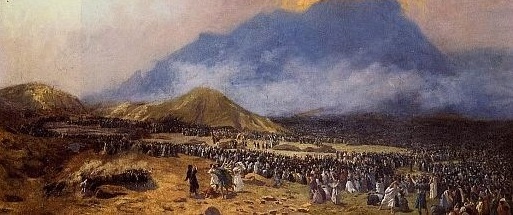
The Bible makes a claim about the number of Israelites that escaped Egypt with Moses (known as the “Exodus”):
The Israelites journeyed from Rameses to Sukkoth. There were about six hundred thousand men on foot, besides women and children. Many other people went up with them, and also large droves of livestock, both flocks and herds. [Exodus 12:37-38]
The Bible also states that the Israelites were important to the Egyptians because as slaves they were the workforce of Egypt:
When the king of Egypt was told that the people had fled, Pharaoh and his officials changed their minds about them and said, “What have we done? We have let the Israelites go and have lost their services!” [Exodus 14:5]
This would mean that at the Exodus, ancient Egypt suffered a catastrophic loss of most, if not all, of its labour workforce. According to the Bible there were 600,000 Israelite men that came out of Egypt. If you factor in women and children that figure would be closer to a few million. The problem is that there is absolutely no evidence of this historical event. There are no ancient Egyptian records of the sudden disappearance of millions of their people. There is also no physical evidence of settlements out in the desert where all these people and livestock encamped. From a purely practical point of view, how did Moses wake up and mobilise millions people in the middle of the night without being detected by the Egyptians?
The Qur’an’s account of this event is far more historically accurate and realistic as it says that it was actually only a small group of Israelites that escaped from Egypt:
And We inspired to Moses, “Travel by night with My servants; indeed, you will be pursued.” Then Pharaoh sent among the cities gatherers [And said], “Indeed, those are but a small band” [Chapter 26, verses 52-54]
This is in line with what modern historians say, if there was an exodus then it couldn’t have happened on the massive scale that the Bible claims.
10. Dealing in usury.

The Bible describes the practice of dealing in usury as one of the worst sins:
He lends at interest and takes a profit. Will such a man live? He will not! Because he has done all these detestable things, he is to be put to death; his blood will be on his own head. [Ezekiel 18:13]
Jews are forbidden from charging interest when lending money to other Jews:
If you lend money to one of my people among you who is needy, do not treat it like a business deal; charge no interest. [Exodus 22:25]
How is it, then, that usury is permitted with non-Jews (referred to as “foreigners”):
You may charge a foreigner interest, but not a fellow Israelite, so that the LORD your God may bless you in everything you put your hand to in the land you are entering to possess.[Deuteronomy 23:20]
Surely a sin is a sin, regardless of who is sinned against? By comparison the Qur’an comprehensively condemns the practice of usury:
Allah destroys interest and gives increase for charities. And Allah does not like every sinning disbeliever. Indeed, those who believe and do righteous deeds and establish prayer and give zakah will have their reward with their Lord, and there will be no fear concerning them, nor will they grieve. O you who have believed, fear Allah and give up what remains [due to you] of interest, if you should be believers. And if you do not, then be informed of a war [against you] from Allah and His Messenger. But if you repent, you may have your principal – [thus] you do no wrong, nor are you wronged. [Chapter 2, verses 276-279]
Notice how the Qur’an not only declares unlawful all acts of usury going forward, it also commanded believers to give up what was owed to them in interest from past loans, with only the original sum of the loan being lawful and not a penny more. The Qur’an also criticises the Jews for practising usury when it had been forbidden for them in the original Torah, this seems to indicate that the verses which permit usury against non-Jews in the Torah have been falsified:
For wrongdoing on the part of the Jews, We made unlawful for them [certain] good foods which had been lawful to them, and for their averting from the way of Allah many [people], And [for] their taking of usury while they had been forbidden from it, and their consuming of the people’s wealth unjustly. And we have prepared for the disbelievers among them a painful punishment. [Chapter 4, verses 160-161]
What should be fresh in our minds is the recent turmoil in the financial markets which was caused by unscrupulous practices such as dealing in usury.
CONCLUSION
Any claims that the author of the Qur’an copied and plagiarised the Bible are completely without substance. When one copies they do so blindly, one does not copy and then make corrections and improvements. As we have seen, many of the corrections found in the Qur’an could not have been known by any human author as they required knowledge of the unseen. Were the Qur’an the product of a human mind, or tampered with by human hands, then it too would be filled with mistakes just like the Bible. From where, then, did the Qur’an originate? The Qur’an answers:
Your Companion [Muhammad] is neither astray nor being misled. Nor does he say (aught) of (his own) desire. It is no less than inspiration sent down to him. He was taught by one mighty in Power. [Chapter 53, verses 2-5]
http://manyprophetsonemessage.com/








 How the Qur’an Corrects the Bible



 Reply With Quote



 Originally Posted by شمائل



Bookmarks